immunoBON® in hayfever
Exhausted by Allergy? – immunoBON®
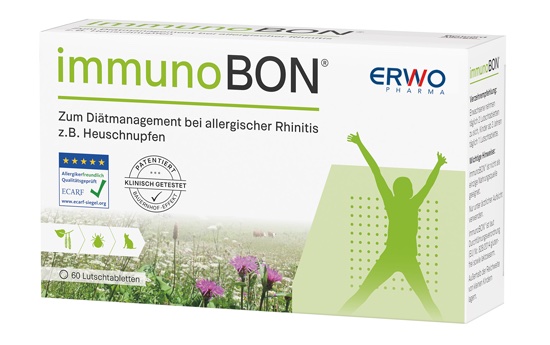
In the patented immunBON® formula, the whey protein beta-Lactoglobulin is provided in a combination with micronutrients. Thereby, immunoBON® mimics the positive nutritional effects of raw milk from dairy farms in a safe manner. Scientific and clinical studies demonstrate that immunonutrition with immunoBON® is useful for dietary management of allergic rhinitis, including hayfever.


Scientific Publications with immunoBON®
Ameliorating Atopy by Compensating Micronutritional Deficiencies in Immune cells: a double-blind placebo-controlled study. Bartosik T, Jensen SA, Afify SM, Bianchini R, Hufnagl K, Hofstetter G, Berger M, Bastl M, Berger U, Rivelles E, Schmetterer K, Eckl-Dorna J, Brkic F, Vyskocil E, Kramer MF, Guethoff S, Jensen-Jarolim E, Roth-Walter F. Journal of Allergy and Clinical Immunology in Practice Jul;10(7):1889-1902.e9. 2022 Mar 6:S2213-2198(22)00229-X. doi: 10.1016/j.jaip.2022.02.028. SUMMARY: In this high-caliber, double-blind, placebo-controlled study, 51 women were enrolled and blinded to immunoBON® or placebo lozenges for 6 months. This pilot study was conducted exclusively on female subjects because immunoBON® was expected to have stronger effects on women. Supplementation with immunoBON® took place over 6 instead of 3 months because it was not yet known how quickly the immunoBON® effect would occur. The patients with hay fever against birch pollen or grass pollen experienced a significant improvement in their nasal symptoms of 42% as a result of taking immunoBON®, while the placebo group only experienced a 13% improvement. In the analyses of the immunological changes, particular emphasis was placed on the iron balance of the individual immune cell and it was shown that immunoBON® was able to introduce iron into the target cells via the “holoBLG” formula and thus contribute to a reduction in inflammation. This clinical study caused a sensation because it was not known that dietary measures could have such a strong effect on hay fever and was scientifically published in a top allergy journal.
Targeted micronutrition via holo-BLG based on the farm effect in house dust mite allergic rhinoconjunctivitis patients – first evaluation in a standardized allergen exposure chamber. Bergmann KC, A. Graessel A, Raab J, Banghard W, Krause L, Sylvia Becker S, Sebastian Kugler S, Zuberbier T, Ott VB, Kramer MF, Roth-Walter F, Jensen-Jarolim E, Guethoff S. Allergo Journal International. Published 22 February 2021 DOI:10.1007/s40629-021-00163-9Corpus ID: 231981905. SUMMARY: In house dust mite allergy, chronic allergic inflammation, especially in the nose (rhinitis), occurs due to year-round exposure, especially during sleep and indoors. The micronutrient deficiency in immune cells caused by the chronic inflammation further fuels the inflammation. This study investigated whether immunoBON® with the included “holoBLG formula” is suitable for the management of rhinitis caused by house dust mites. 32 house dust mite allergy sufferers were supplemented with immunoBON® twice daily for 3 months. They were then exposed to house dust mite allergens in a tested and internationally recognized allergen exposure chamber for 120 minutes and the symptoms were compared with those beforehand. The allergic symptoms in the nose and eyes were recorded every 30 minutes. Patients who had taken immunoBON® had up to 60% less symptom load in the nose, all symptoms together were reduced by 40%. This scientific study thus shows that immunoBON® is able to manage allergic rhinitis caused by house dust mites through micro-nutrition.
Long-term benefits of targeted micronutrition with the holoBLG lozenge in house dust mite allergic patients. Bergmann KC, Raab J, Krause L, Becker S, Kugler S, Zuberbier T, Roth-Walter F, Jensen-Jarolim E, Kramer MF, Graessel A. AllergoJournal, 2022, https://doi.org/10.1007/s40629-021-00197-z SUMMARY: The above-mentioned house dust mite study raised the question of how long the immunoBON® effect lasts. 27 of the 32 patients with house dust mite allergy could be recalled 7-8 months after completion of the first study, i.e. 7-8 months after completion of supplementation with immunoBON®, to undergo another allergen challenge in an allergen challenge chamber (AEC). The analysis showed that these individuals still benefited from a 20% improvement in nasal symptoms and 40% improvement in all symptoms tested. It has therefore been scientifically proven that house dust mite allergy sufferers continue to enjoy long-term benefits for over six months after taking the product for three months, and benefit because they have fewer symptoms. However, the immunoBON® effect decreases, so we recommend repeated 3-month use at approximately ½-year intervals, or at least once a year.
The holoBLG lozenge reduces symptoms in cat allergy – evaluation in an allergen exposure chamber and by titrated nasal allergen challenge. Bergmann KC, Raab J, Graessel A, Zwingers T, Becker S, Kugler S, Zuberbier T, Roth-Walter F, Kramer MF, Jensen-Jarolim E. Clinical Translational Allergy, 2023: Vol. 13 (7), p 1-10, e12274. SUMMARY: Chronic inflammation also causes micronutrient deficiencies in immune cells in cat allergies. This study therefore investigated whether immunoBON® is suitable for use in cat allergy. 35 allergy sufferers affected by allergic rhinitis to cats took immunoBON® twice daily for 3 months. Before and after supplementation, the study participants had to spend 120 minutes sitting in a tested and internationally recognized allergen exposure chamber (AEC) while being dusted with cat allergen. Their allergic symptoms such as rhinitis, sneezing, itching in the eyes and throat, and airflow through the nose were recorded every 30 minutes. Patients taking immunoBON® had up to 50% less symptom burden and their airflow through the otherwise blocked nose was significantly improved. In particular, the known late reactions that occur after one day were also significantly reduced. It has thus been scientifically proven that a dietary intervention with immunoBON® can also be used sensibly for cat allergies. immunoBON® therefore has a dietary effect on allergic rhinitis regardless of the type of allergy (pollen, mites, cat).
Micronutritional supplementation with a holoBLG-based FSMP (food for special medical purposes)-lozenge alleviates allergic symptoms in BALB/c mice: Imitating the protective farm effect. Afify SM, Regner A, Pacios LF, Blokhuis BR, Redegeld FA, Pali-Schöll I, Bartosic T, Petje L-M, Hufnagl K, Guethoff S, Kramer M, Fiocchi A, Dvorak Z, Jensen-Jarolim E, Roth-Walter F. Clinical Experimental Allergy, 2022 Mar;52(3):426-441. SUMMARY: Before a clinical trial can be carried out using a new method of allergy management, its effectiveness must be tested in the laboratory and also in a mouse model. Previous basic scientific studies have already shown that the main component of immunoBON® “holoBLG”, a whey protein loaded with micronutrients, can favorably influence immune cells against the allergy by providing micronutrients. Supplementation with holoBLG also proved to be beneficial and immune-boosting in the mouse model. In the above-mentioned study, the final immunoBON® lozenge formulation, as it should be used as a dietary food for specific medical purposes (FSMP) in humans, was fed to allergic mice in comparison with a placebo lozenge. The results showed that immunoBON® restored immune resilience – immune strength – in these mice via the delivery of micronutrients. This proof of efficacy of the final lozenge composition in the preclinical mouse studies demonstrated that immunoBON® could also be effective in humans.